Americas Oil Supply Routes
Status of the critical maritime chokepoints and infrastructure affecting Western Hemisphere fuel supply. The transit, port-flow and sea-state panels below refresh daily from satellite-AIS and weather feeds; the chokepoint risk assessments further down are maintained editorially.
→ Strait of Hormuz crisis timeline — a sourced, filterable chronology of the 2026 crisis.
Live Global AIS — Shipping & Tanker Traffic
Map: VesselFinder →Illustrative, not a count. Live positions of vessels broadcasting AIS worldwide — pan and zoom to any region or chokepoint. Ships running dark (AIS off) or affected by GPS spoofing do not appear, so this is a live picture, not a measure of traffic. For chokepoint transit counts — the authoritative figures — see the Hormuz throughput and IMF PortWatch panels below. Map data © VesselFinder.
Global Supply Chokepoints — Risk Overview
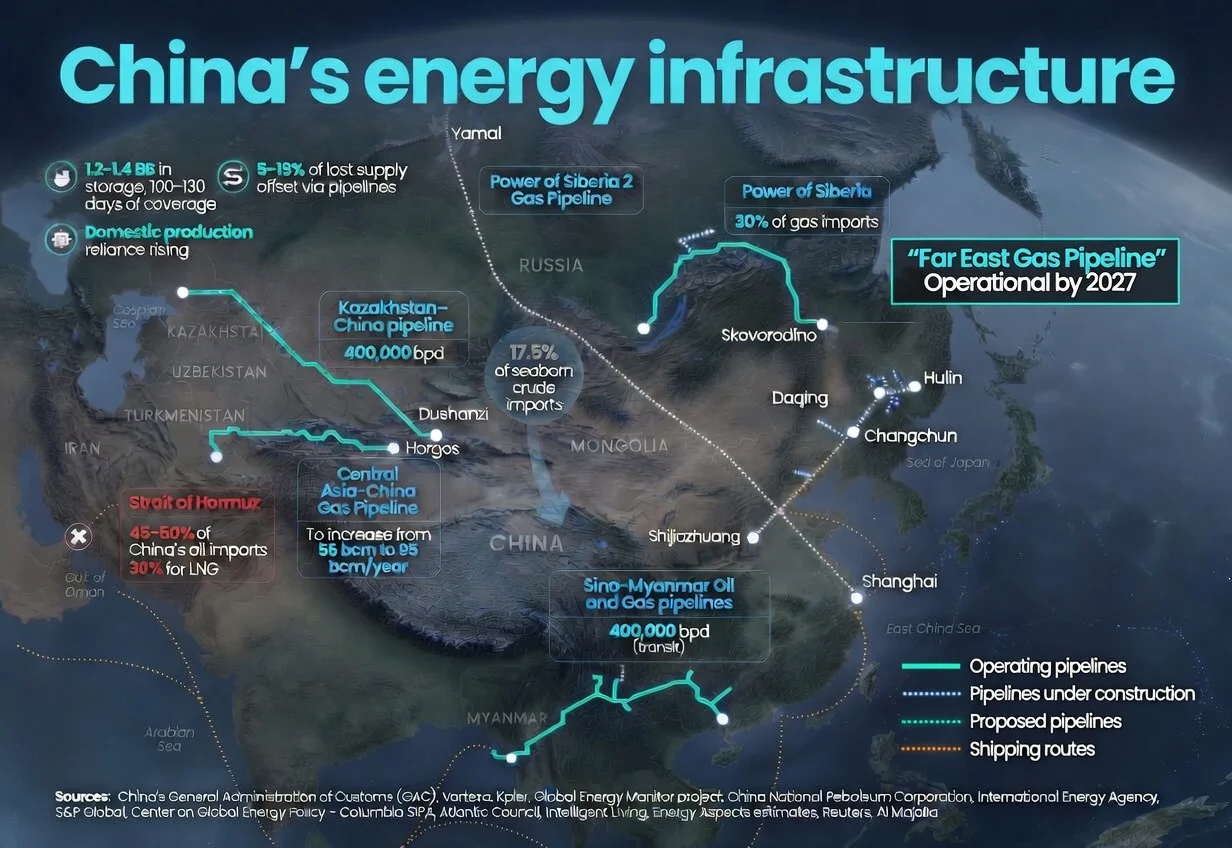
31 August 2026 — A corridor, a mine-free declaration — and the ships still did not return
- Live data updated
- 27 Sep 2026
- Assessment reviewed
- 31 Aug 2026
What was rechecked. Three things happened after the note below. On 25 August Iran and Oman issued a joint statement setting out a temporary joint maritime corridor and a joint mine-clearance project, with Tehran conditioning implementation on US steps it has not published. On 27 August CENTCOM commander Admiral Brad Cooper declared the internationally recognised lanes free of Iranian sea mines. On 30 August US forces struck two Iranian launchers on Larak Island, saying Revolutionary Guard units were preparing to fire rockets carrying sea mines into the strait — an account not independently established — and Iran fired missiles at US positions in Jordan, which reported intercepting eight without damage. It was the first direct exchange in about a month.
The measurement that matters is the one that did not move. With a corridor agreed and the lanes declared clear, Kpler still counted 10 visible commodity vessels on Wednesday 26 August and 8 on Tuesday, against a ten-day moving average near 15 and pre-war traffic above 130 a day; tracking estimates put movement at roughly 5–15% of normal. Visible counts exclude AIS-dark transits and are a floor, not a census — but the floor did not rise when the stated obstacles were removed. A corridor that exists diplomatically is not a corridor that operates commercially.
Status, stated plainly. Hormuz: NOT reopened; corridor agreed but unimplemented, lanes declared clear, traffic still a fraction of normal. Larak is an escalation in disruption risk, not a verified new supply loss — no further export interruption has been confirmed. Brent returned above $90 ($90.32 at 22:02 GMT on 30 August). Next review triggers: a verified fall below the late-August transit level, a confirmed mining attempt, published routing and insurer acceptance for the corridor, or cargo-verified movement resuming.
21 August 2026 — A corridor claim is not a verified flow — and diesel is the US-side symptom
What was rechecked today. The situation in the note below — talks advancing while the Red Sea workaround came under attack — has since moved through a mid-month near-standstill (Kpler counted two visible crossings on 14 August, with no crude visible at all that Friday) to a claimed recovery that remains unverified. Unnamed US officials claimed (Axios, 19 August) a southern corridor along Oman moving 15–20 tankers a night with outbound flows approaching 10 mb/d. Those are attributed claims without cargo-level verification. The cross-check: Kpler observed seven commodity ships transiting on 20 August — four in, three out, none a VLCC or LNG carrier — figures that exclude AIS-dark traffic. A corridor claim is not the same thing as verified oil flow.
The US-side symptom is refined products, not crude. The US diesel crack set a record near $102 a barrel on 17 August and has hovered near $100 since, with distillate stocks at their lowest for this time of year since the mid-1990s (EIA: 105.6m barrels on 14 August). WTI was near $86.76 and Brent near $93.44 on Thursday morning (Reuters). Crude benchmarks are comparatively stable; the products market is where the disruption is reaching the real economy.
Status, stated plainly. Hormuz: NOT reopened; visible transits remain in single digits. The 9 August note below stands as history, its open questions — reopening conditions, corridor mechanics — still unresolved. Next review triggers: cargo-verified corridor volumes, a sustained return to double-digit daily visible transits, a verified new attack on shipping or export infrastructure, or a decisive move in the diesel crack.
9 August 2026 — Saudi refinery hit again as the Hormuz workaround comes under fire
Two things moved today and they point in opposite directions. On Hormuz, Iranian Foreign Minister Abbas Araqchi said the Iran–Oman shipping-lane agreement is in its final stages — but also that it would not by itself reopen the Strait, saying reopening depends on further US actions including compensation for attacks on Iran. Separately the IRGC said the Strait reopens when Washington accepts Iran’s conditions, and Mohammad Baqer Zolqadr, secretary of Iran’s top national-security body, listed broader demands including lifting sanctions and the blockade and ending attacks on Iran and its regional allies. Three speakers, three different claims — reported separately rather than merged into one Iranian position.
Meanwhile the route around Hormuz was attacked. The Houthis said they struck Saudi Aramco’s 400,000 b/d Jazan refinery on the Red Sea coast with a drone, spokesman Yahya Saree calling the strike precise and framing it as a response to Saudi drone incursions over Saada and Hajjah. Saudi Arabia’s energy ministry confirmed a fire at the facility, said it was extinguished and reported no injuries — without stating a cause. The claim and the confirmation come from different parties; only the fire is officially established. The refinery had already been shut after the late-July attack.
Why the pairing matters more than either item alone. Jazan sits on the Red Sea side of Saudi Arabia’s workaround to Hormuz — the corridor that lets Aramco move refined product without transiting the strait. One chokepoint is negotiating a route back toward normal while the alternative corridor becomes less secure. That is what the market has to price, and Brent’s $83.55 close on Friday (+1.3%, Reuters) reflects a market still waiting for clarity rather than one that has resolved anything.
Status, stated plainly. Hormuz reopening: NOT AGREED. Iran–Oman shipping lanes: final stages, per Araqchi. Reopening conditions: unresolved. A lane design describes where ships would go if the strait reopened — not whether it will. Any headline reading “deal close” as “reopening imminent” is a misreading of what was actually said today.
8 August 2026 — Iran and Oman agree a route; eight vessels crossed
The negotiating pause below has produced something concrete. Iran says it has reached agreement with Oman on a proposed shipping route through Hormuz, with a joint statement in final drafting (Foreign Ministry spokesman Esmail Baghaei, 5 August, via Bloomberg). The reported framework routes inbound vessels near the Iranian side and outbound vessels down the Omani side, imposes no transit or service fees, and may include regional participation in demining; Deputy Foreign Minister Kazem Gharibabadi told IRNA it is a temporary route intended to run two to four months. Fortune reports (7 August) that the emerging deal recognises Iran’s control of the waterway. NPR called a partial reopening “close” on 6 August.
An agreed route is not a reopened strait. Kpler counted eight vessels crossing on 5 August — five tankers and three bulk carriers — against more than 100 a day before the conflict. That is the same order of magnitude as the single-digit weekends recorded on 27 July, so on the only metric that measures actual movement, nothing has yet changed. A return to normal tanker, LNG and container flows plausibly requires several consecutive weeks of incident-free transits, published routing protocols, credible mine clearance and a stable US–Iran political agreement — none of which is in place.
Futures have traded the negotiation rather than the flow: Brent hit a three-week low of $79.36 on 4 August, settled $79.45 on 5 August, then recovered to $83.55 on 7 August (+$1.06, +1.3%) as the terms of who would control the strait came back into doubt (Reuters). Friday’s settlement is the latest available; 8 August is a Saturday.
Provenance, so nothing is rolled forward silently. Two figures in the 2 August note below have not been refreshed and should not be read as current: the ~25 Bab el-Mandeb crossings, which was already a floor rather than a count because vessels run dark, and the Kirkuk–Ceyhan ~170–180,000 b/d flow against 750,000 b/d of reserved capacity. Both are dated 2 August and stand as of that date only. Note also that vessel counts and barrel-per-day flow estimates are different metrics measured by different methods — they are not interchangeable, and a recovery in one does not evidence a recovery in the other.
2 August 2026 — Negotiating pause at Hormuz; the water stays dangerous; Kirkuk–Ceyhan extended
President Trump says the planned strikes on Iranian energy targets are cancelled or postponed while Gulf governments try to complete a deal covering Iran’s nuclear programme and the “immediate, complete and total” reopening of Hormuz; Israel is said to have joined, Iran has not publicly accepted, and no verified reporting shows normal traffic resuming. The weekend produced two tanker incidents regardless: a vessel disabled by an unknown projectile off Limah (engine room hit, “not under command”), and a reported explosion close alongside a second tanker ~21nm north-west of Khasab — both unattributed. Hormuz is permitting, or failing to prevent, individual passages; Bab el-Mandeb improved to ~25 crossings but every count is a minimum with ships running dark; SUMED loadings have surged (Sidi Kerir 28.79M bbl for July, per Kpler via Reuters) even as a drone struck gas vessels at Damietta, and CPC has suspended loadings twice in a week. One durable positive: Turkey and Iraq extended the Kirkuk–Ceyhan pipeline deal by a year — reserved capacity up to 750,000 b/d against ~170–180,000 flowing, a Mediterranean outlet for Iraqi crude that needs no strait transit, secured on conditions. A pause in the shooting is not a reopening of the sea.
27 July 2026 — The shooting has paused; the shipping crisis has not
Financial markets are pricing a pause; the physical system is not. Brent fell more than 6% on Monday to about $90.58 a barrel (WTI ~$83.51) after the US and Iran refrained from striking each other for a second consecutive day, with Oman and other intermediaries working to restore the interim ceasefire framework and negotiate Hormuz shipping arrangements — roughly $11 of war premium out since Brent reached about $102 on 23 July. But traffic through both chokepoints stayed severely depressed. Hormuz ran in single digits over the weekend — about seven commodity vessels Friday, three Saturday (all dark) and seven Sunday (Kpler) — so the strait has not meaningfully reopened. Bab el-Mandeb fell to just 11 crossings on Sunday (seven of them oil tankers), the lowest in months, after the Houthi strikes on Jizan and Yanbu, though several large VLCCs carrying Saudi, Emirati and Russian crude still escaped south toward Asia. Physical crude cargoes reached two-month highs last week and roughly 10 mb/d of Middle Eastern barrels may still be displaced. The signal has changed; the supply system has barely changed — market de-escalation without physical normalisation, with the US naval blockade still operating and the nuclear dispute unresolved.
21 July 2026 — Ceasefire collapses again; Houthis declare an embargo on all ships to Saudi ports
The interim 17 June truce has broken down and US strikes have run a tenth consecutive night (CENTCOM), with Iran striking a Kuwaiti power and desalination plant. The Red Sea threat is now concrete: in an email to shipowners seen by Bloomberg, Yemen’s Houthis warned their reimposed blockade covers all ships calling at Saudi ports — not just Saudi-flagged vessels — directly threatening Yanbu, the Red Sea outlet Saudi Arabia uses to bypass Hormuz. Enforcement is unproven, and a Saudi-led coalition says it has begun protective measures at Bab el-Mandeb. Hormuz itself runs at a near-halt — about four commodity vessels crossed Monday (Kpler), every one dark. Brent touched $91.42 Monday, its highest since 11 June, before easing to about $89 on hopes of a fresh ceasefire, while European low-sulphur gasoil hit a record premium near $60/bbl over Brent. The dated detail below remains the fuller background.
13–14 July 2026 — Both powers claim Hormuz: Iran declares it closed; the US drops its 20% toll but tightens a full Iran blockade
The US–Iran conflict has escalated sharply since the July ceasefire collapsed. Over the weekend Iran’s IRGC declared the Strait of Hormuz closed “until further notice” — after its forces struck the Cyprus-flagged container ship GFS Galaxy (engine-room fire, crew evacuated to a lifeboat, one crew member missing; CENTCOM). The US answered with further rounds of strikes, the latest on Sunday using one-way attack sea drones for the first time, and Iran retaliated across Kuwait, Jordan, Qatar, Bahrain and Oman — including the first strike on Gulf oil infrastructure in weeks, a Kuwaiti drilling facility. Oil jumped at Monday’s open, Brent trading above $79 and WTI near $74; by Tuesday Brent had pushed above $85, a four-week high, as the war premium returned in force.
On Monday the US hardened its claim over the strait: in a Truth Social post President Trump declared Hormuz “OPEN… with or without Iran,” reinstated a US blockade of Iranian ships and customers, styled the United States the “Guardian of the Hormuz Strait,” and proposed a 20% fee on all cargo transiting the waterway, the process to “begin immediately.” Iran’s Persian Gulf Strait Authority countered that passage was “currently unfeasible” and suspended transit permits. Both powers now assert a right to control — and charge for — the chokepoint, days after the IMO Council ruled that transit through international straits may not be tolled. On Tuesday, after backlash from shippers and the IMO ruling, Trump abandoned the 20% fee — replacing it with a push for Gulf trade and investment deals — while keeping a full blockade on Iran-linked shipping (vessels to or from Iranian ports, or carrying Iranian cargo), which CENTCOM began enforcing that afternoon.
Iranian officials say a US projectile hit the perimeter area of the Bushehr nuclear power plant, and Reuters has carried the perimeter claim — but there is no independent confirmation that the reactor itself was hit. Earlier IAEA and Reuters reporting on previous Bushehr incidents found no reactor damage or radiological release; no fresh IAEA confirmation has yet been seen for this latest strike.
Reuters ship-tracking found at least four oil and gas tankers reversed course near the strait; others continued to transit. The strait’s status is now openly contested — Iran declares it closed while the US and CENTCOM insist it stays open to lawful transit, and the JMIC says the Oman-coordinated southern lane remains available. The US Navy-led Joint Maritime Information Center has raised the transit threat to “severe” — up from “substantial,” its highest since mid-June — and the IMO Secretary-General has urged shipowners not to expose crews to unnecessary danger by transiting while safety cannot be assured. Brent spiked about 6% to near $80 as the fighting resumed, round-tripped to about $76 by Friday, then jumped back above $79 at Monday’s open and above $85 by Tuesday.
A fresh JMIC advisory (013-26, 10 July) keeps the threat level at “severe” but stresses the strait stays open: the southern transit route has been expanded and remains available to all traffic, coordination with NAVCENT’s NCAGS is offered but not mandatory, and — pointedly — “there is no controlling authority regulating passage or fee required for any route.” US NAVCENT added that “no nation has the authority to close or control the Strait of Hormuz,” with US forces prepared to defend freedom of navigation. Mariners are warned of a mine-danger area in the traditional traffic-separation scheme and to expect VHF hailing from naval forces.
War-risk insurance underlines the caution. Marsh, the world’s largest marine broker, says premiums to transit Hormuz now run 2–6% of a vessel’s value — up from a fraction of a percent before the war, having peaked near 10% at the height of the fighting (large no-claim discounts often trim the headline rate). Brokers report fewer requests for quotes since the ceasefire frayed this week, though cover remains available (Bloomberg, 9 Jul). The Lloyd’s Joint War Committee has listed the whole Gulf as high-risk since March — a listing that adds cost and a notification duty but does not bar transit.
On a second front, Ukraine’s drone campaign in the Sea of Azov has escalated sharply. Its Unmanned Systems Forces say they have struck Russian shadow-fleet shipping — the tankers that move sanctioned oil and products — across a nine-day operation, with Kyiv now putting the total at 116 vessels(an unverified claim; ~76, including 21 tankers, was the earlier multi-sourced count). In response Russia suspended shipping through the Kerch Strait and the Don–Azov Canal (FSB Border Service, from 10 July) and says it may divert to Black Sea and Baltic ports — a self-imposed chokepoint closure that cut Azov AIS traffic roughly55% (Starboard Maritime). With up to a quarter of Russian wheat exports transiting the Azov, Euronext wheat jumped about 4% to a six-week high. The IMO Secretary-General condemned the Azov and Black Sea attacks, warning the focus on Hormuz should not overshadow threats elsewhere; Russia’s Lavrov called them “terrorism,” while Kyiv says it strikes only military or war-supporting assets. Neither side’s figures are independently verified (Reuters, TWZ, gCaptain).
Sources: Reuters, WSJ, Bloomberg, JMIC 013-26, NAVCENT/NCAGS, Lloyd’s JWC, IMO, CENTCOM, UKMTO. Available footage and Tier-1 reporting attribute the “cancer” remark to Iran’s government and leadership — not the Iranian people, and not a call for their eradication.
Strait of Hormuz — Tanker Throughput
vs 2023 baselineVessel count · primary measure
2%of 2023 baseline
▼ down from ~26% peak (2026-07-07)
Transits
1/day
2% of 2023
Cargo
~0.1 mb/d
derived ×7.33
Capacity
1%
secondary · mix-sensitive
Tanker movements through Hormuz collapsed to zero at the height of the conflict, recovered to about 26% of the 2023 count baseline by 2026-07-07, and have since fallen back to about 2% in the seven days to 2026-09-27. PortWatch observed 9 tankers across that week; the 2023 average was 55.5/day.
Count is the headline because capacity is sensitive to vessel mix — at these volumes one large tanker can dominate a week's tonnage without a comparable change in the number of movements. Both figures are measured against PortWatch's own 2023 baseline for the same field.
Read it as a floor. This is an AIS-based count, and a meaningful share of post-conflict Hormuz traffic runs with transponders off (dark transit) or via evasive routing — so true movement is likely higher than the figure shown.
Aggregate strait transits (all tankers, all origins) — not by-country loadings or empty-tanker inflows, which require paid vessel intelligence. mb/d derived from cargo tonnage at 7.33 bbl/tonne.
Source: IMF PortWatch · satellite-AIS chokepoint transits · latest 2026-09-27
Strait of Hormuz — Force Posture
Operation Epic Fury · reported, not live positionsUS / Coalition
- Carrier strike groupsconfirmed
The U.S. briefly surged three aircraft carriers into the Middle East in April — Ford, Lincoln and George H.W. Bush — per CENTCOM-cited reporting at the time (the first three-carrier presence there since 2003). By July, open-source fleet trackers and Navy releases point to a two-carrier posture in the Arabian Sea, centred on USS Abraham Lincoln and USS George H.W. Bush, with amphibious big-deck ships (Tripoli, Boxer) also in the region. USS Gerald R. Ford returned to Norfolk on 16 May after an 11-month deployment and is not part of the July posture.
USNI Fleet & Marine Tracker (7 Jul) · Navy releases (11 Jul) · Breaking Defense (Apr) · AP (Ford return) · confirmed 11 Jul
- Freedom-of-navigation postureconfirmed
CENTCOM states the strait is open to lawful transit and its forces are positioned to ensure it (“Iran does not control the strait. Traffic is flowing.”). After thirteen consecutive nights of strikes on Iranian coastal military targets, US strikes paused from 25 July and had held for a second consecutive day by the 27th while Oman-brokered diplomacy proceeds; the US naval blockade of Iran-linked shipping remains in force. “Open,” though, has not meant “normal” — Hormuz traffic is still running at single digits a day.
CENTCOM / Washington Times · confirmed 27 Jul
- Mine countermeasuresconfirmed
US naval mine-clearance missions reported in the strait; President Trump has instructed the Navy to fire on Iranian vessels caught laying mines.
CENTCOM reporting · confirmed 12 Jul
Iran (IRGC Navy / IRIN)
- Fast-attack craft (swarm)assessed
Large inventory of small fast-attack craft (Zolfaghar- and Peykaap-class) built for asymmetric hit-and-run swarm tactics — speed, dispersion and saturation to surround a vessel; armed with heavy machine guns, rockets and short-range anti-ship missiles.
IISS / CNN ‘mosquito fleet’ · confirmed 8 May
- Coastal anti-ship missilesassessed
Coastal ASCM batteries and craft-mounted missiles — e.g. the short-range Nasr-1 and the Zafar (≈250 km, subsonic, INS/GPS) — designed to salvo against merchant and naval vessels transiting the strait.
Strauss Center / US ONI · confirmed 15 May
- Naval minesassessed
Substantial sea-mine inventory — the classic Hormuz-closure tool and the trigger for the US mine-clearance operations now under way.
Strauss Center · confirmed 12 Jul
- Submarines & recent activityassessed
IRGC Navy has put submarines and fast boats into the strait (Maritime Security Belt 2026 exercise) and has attacked commercial vessels with fast-attack craft in recent weeks.
Army Recognition / reporting · confirmed 11 Jul
- Key basesassessed
Bandar Abbas (principal IRGCN/IRIN base) and Jask, plus dispersed coastal sites along the northern shore of the strait.
Strauss Center · confirmed 1 Jun
Recent incidents · from the crisis timeline
- 22 SeptSaudi Arabia restarts the East-West pipeline at a low rate, beginning to restore the Hormuz bypass · Reuters — Saudi Arabia restarts East-West oil pipeline, sources say
- 21 SeptShip-to-ship shuttle network expands as Gulf producers keep exports moving through Hormuz · Reuters Open Interest — Hormuz shuttles keep oil flowing, but at a high cost
- 21 SeptVisible Hormuz traffic falls to two vessels as a crude tanker and LPG carrier are struck in separate incidents · Reuters — Hormuz vessel traffic falls to two, data shows
- 16 SeptVisible Hormuz transits fall to three vessels, well below the ten-day average · Reuters — Number of ships transiting Strait of Hormuz falls to three on Wednesday, data shows
Full chronology: Strait of Hormuz crisis timeline →
Reported open-source posture — approximate, drawn from public agency statements, wire reporting and reference works, NOT live tactical positions. Exact locations and counts are not publicly confirmed and change constantly. 'Confirmed' = stated in official/agency reporting; 'Assessed' = analyst or reference estimate (e.g. IISS, ONI, CSIS).
Chokepoint Transit Monitor
Tanker tonnage (DWT) vs 2023 baseline · IMF PortWatch (AIS estimates)Strait of Hormuz tanker tonnage is at 1% of normal, with Bosporus Strait and Bab el-Mandeb Strait and Suez Canal also restricted; traffic is rerouting via the Cape of Good Hope (180% of baseline).
Crude- and product-carrying capacity actually moving through each chokepoint — weighted by tanker size (a VLCC isn’t a coastal product tanker).
Latest data 2026-09-27 (≈3 days ago) — PortWatch reports in arrears, so it confirms shifts after the fact, not in real time. The % is tanker capacity (DWT) vs the 2023 daily average (trailing 7-day); ship counts shown for context. Lanes marked AIS low are conflict zones where spoofing, jamming or vessels going dark mean these figures are a floor — a significant share of Hormuz traffic runs with transponders off, so true movement is likely higher. Source: IMF PortWatch — estimated from satellite AIS, not customs data. PortWatch does not tell us the exact barrel, grade or buyer — only whether the ships needed to move the oil economy are actually moving.
Panama Canal Watch
Live transit vs 2023 · IMF PortWatch (AIS estimates)The Western Hemisphere’s key chokepoint — the Pacific↔Atlantic shortcut that keeps US Gulf and East Coast cargoes off the long route around South America.
Watch the draft, not just the count: Panama’s throughput is rationed by Gatún Lake water levels, and drought has forced deep transit cuts before (2023–24). A dry season that lowers the lake squeezes daily slots and pushes more tonnage onto the longer Cape Horn / Suez routes. As of July 2026 the Authority is again trimming Neopanamax draft (49.5→48.5 ft by mid-August) — precautionary, to bank water ahead of an expected very-strong El Niño, even as transits run above the 2023 norm for now. Latest data 2026-09-27 (PortWatch reports ~a week in arrears). Source: IMF PortWatch — transit estimated from satellite AIS, not canal-authority counts.
Port Oil-Flow Monitor
Tanker import/export vs 2023 baseline · IMF PortWatch (AIS estimates)Crude and product moving through major hubs — daily tanker tonnage in (↓) and out (↑), with how it compares to the 2023 average. Where the barrels are actually going.
Americas
Global oil hubs
Latest data 2026-09-25 (PortWatch reports ~a week in arrears — it confirms shifts after the fact, not in real time). Volumes in thousand tonnes/day (kt/d), trailing 7-day average vs 2023. Source: IMF PortWatch — tanker tonnage estimated from satellite AIS, not customs data; some terminals (e.g. Gulf export ports) are under-covered and read low.
Live Sea State — Oil Shipping Chokepoints
Significant wave height, wave period, and 10-metre wind speed. Updated 29 Sept, 12:40 UTC.
Strait of Hormuz
Persian Gulf / Gulf of Oman
0.28m
wave height
3.0s
period
10ktSSE
wind
Bab el-Mandeb
Red Sea / Gulf of Aden
0.36m
wave height
2.7s
period
14kt · g25ESE
wind
Panama Canal (Caribbean approach)
Caribbean
0.48m
wave height
5.8s
period
2kt · g6ENE
wind
Strait of Florida
Gulf of Mexico / Atlantic
0.32m
wave height
4.1s
period
6ktSE
wind
Source: Open-Meteo Marine + Forecast APIs (sourced from European met agencies). Risk band uses Douglas-style sea-state (wave height) and Beaufort-style wind thresholds; whichever is worse sets the band. open-meteo.com ↗
Current Route Status
Risk levels: Normal · Elevated · High · Critical
US Maritime Security Advisories
MARAD active advisories relevant to Americas supply routes · Updated Sep 29, 2026
Red Sea, Bab el Mandeb Strait, Gulf of Aden, Arabian Sea, and Somali Basin
Houthi Attacks on Commercial Vessels
Persian Gulf, Strait of Hormuz and Gulf of Oman
Iranian Attacks on Commercial Vessels
Gulf of Aden, Arabian Sea, Indian Ocean
Piracy/Armed Robbery/Kidnapping for Ransom
Global
U.S. Maritime Advisory Updates, Resources, and Contacts
Red Sea, Bab el Mandeb Strait, Gulf of Aden, Arabian Sea, and Somali Basin
Houthi Attacks on Commercial Vessels
Red Sea, Bab el Mandeb Strait, Gulf of Aden, Arabian Sea, Persian Gulf, and Somali Basin
Houthi Attacks on Commercial Vessels
Gulf of Aden, Arabian Sea, Indian Ocean
Piracy/Armed Robbery/Kidnapping for Ransom
Strait of Hormuz and Gulf of Oman
Iranian Illegal Boarding / Detention / Seizure
Global
U.S. Maritime Advisory Updates, Resources, and Contacts
Source: US Maritime Administration (MARAD). Full advisory text on MARAD site.
Thermal Anomalies — Major Refineries & Terminals
NASA FIRMS VIIRS satellite detections within ~15 km of major US Gulf, US East/West Coast, Caribbean and Latin American refineries. Past 24 h. High Fire Radiative Power near a facility may indicate flaring, fire, or process incident — not all detections indicate incidents.
Energy Research — CREA
Russian fossil fuel exports, Hormuz impacts & Americas supply analysis · Updated Sep 29, 2026
China Energy and Emissions Trends – August 2026 snapshot
August 2026 — Monthly analysis of Russian fossil fuel exports and sanctions
China Air Quality Trends – August 2026 Snapshot
Analysis: China’s CO2 emissions fall in Q2 2026 due to plummeting oil use
What the Hormuz crisis has cost fossil fuel importers — March to August 2026
China Energy and Emissions Trends – July 2026 snapshot
China Air Quality Trends – July 2026 Snapshot
July 2026 — Monthly analysis of Russian fossil fuel exports and sanctions
India monthly ambient air quality snapshot: July 2026
CREA EU CO2 emissions tracking: Early estimates hold up, provide valuable advance insights for public and policy
Source: Centre for Research on Energy and Clean Air (CREA). · Checked 29 Sept 12:40 UTC
Active Disruption Risk
Strait of Hormuz
Persian Gulf / Gulf of Oman · 26.5°N 56.4°E
Critical — tanker tonnage at 1% of the 2023 norm (live · IMF PortWatch)
The Strait of Hormuz remains the master variable for global oil. After the conflict that began in late February 2026 effectively closed it, the EIA assumed Hormuz stayed shut into late May, with traffic only beginning to pick up in June. Iran now says it will reopen only under new conditions — including possible Oman-set transit fees, which Washington opposes. All major Gulf producers export through this single chokepoint; in practice only a handful of crude, product and LNG vessels have exited recently — often with AIS gaps or under heightened risk — while overall Gulf flows stay far below normal. Open on paper, restricted in practice.
Americas Impact
US Gulf and East Coast refineries that process Gulf sour crude face spot-market tightness. The WTI-Brent spread has moved as Gulf crude stays hard to source globally, and Atlantic-basin producers (US shale, Brazil, Guyana) are the substitution pool. Saudi Arabia cut July official selling prices to Asia by $6/bbl, signalling demand destruction. SPR drawdown contingencies remain in play.
Context
Hormuz is Washington's top priority and Tehran's main leverage in unresolved US–Iran talks. The early-June Israeli strike on Iran's Mahshahr petrochemical complex — the first hit on Iranian energy infrastructure since the April ceasefire — put a direct energy-asset risk premium back on. Even after a reopening, recovery is slow: Kuwait says it could restore ~70% of output within 6–8 weeks, the rest taking roughly another month.
Last reviewed: 2026-06-08
Bab-el-Mandeb Strait
Red Sea / Gulf of Aden · 12.6°N 43.3°E
Critical — MARAD 2026-013: Houthi Attacks on Commercial Vessels
Houthi forces in Yemen have attacked over 100 commercial vessels since November 2023, effectively closing the Red Sea route to most shipping. Combined with the still-constrained Hormuz corridor, both primary Gulf export corridors remain under simultaneous pressure — an unprecedented compound event, with renewed Houthi threats an active watch-item.
Americas Impact
The Cape of Good Hope reroute adds 10-14 days each way and increases shipping costs significantly. For Americas-bound Gulf crude, this compounds with the constrained Hormuz corridor to force spot-market substitution from Atlantic Basin producers (US shale, Brazil, Guyana).
Context
US and allied naval operations (Operation Prosperity Guardian) have not deterred attacks. Most major shipping lines continue to avoid the route. Insurance premiums for Red Sea transits remain at crisis levels.
Last reviewed: 2026-06-08
Normal Conditions
Panama Canal
Central America · 9.1°N 79.4°W
Normal — tanker tonnage near the 2023 norm (104%) (live · IMF PortWatch)
The Panama Canal handles roughly 5% of global seaborne trade and is the only non-Cape route between the Atlantic and Pacific in the Americas. Severe drought in 2023-2024 forced transits down to 24/day (from 36) with 10+ day waits. Transits are currently robust — running above the 2023 norm — but the Canal Authority is again trimming the maximum Neopanamax draft (49.5 ft on 3 Jul → 49.0 ft on 24 Jul → 48.5 ft on 15 Aug), this time preemptively, to bank Gatún Lake water ahead of a dry season NOAA now expects to fall under a very strong El Niño (81% odds for Oct–Dec). The cuts are mild so far — about a foot and a half of draft, not the transit-slashing of 2023-24 — marking the start of the risk window, not an active disruption.
Americas Impact
Panama chiefly carries US Gulf Coast LPG, LNG and refined-product exports to the Pacific and Asia (crude largely cannot fit the locks). A draft cut trims how deep each product tanker can load rather than halting transits; the 2023-24 restrictions, by contrast, diverted LNG/LPG cargoes around Cape Horn and added an estimated $300-500M in annual shipping costs. The escalation path to watch: a very strong El Niño deepening the Dec–Apr dry season toward 2023-24 severity.
Context
Canal expansion completed 2016 allows Neo-Panamax vessels up to 14,000 TEU, but Gatún Lake water levels remain the binding constraint. The Authority's structural fix — the proposed Río Indio reservoir — is still years from delivery, leaving draft-and-slot management as the near-term lever. Alternative routing: Cape Horn adds ~8,000 nautical miles.
Last reviewed: 2026-07-13
Straits of Florida
Caribbean / Southeast US · 24.5°N 80.2°W
Normal — open, routine monitoring
The Straits of Florida (between Cuba and the Florida Keys) carry significant volumes of refined petroleum products northward to US East Coast markets, and crude southward. Major US refineries in the Gulf Coast export through this route.
Americas Impact
No current disruption risk. The strait is under US Coast Guard jurisdiction and routinely monitored. Any disruption would force rerouting around Cuba, adding 2-3 days transit.
Context
US-Cuba relations and Cuban political stability are the primary geopolitical risk factors. Cuba's deteriorating economy and fuel shortages occasionally affect shipping logistics.
Last reviewed: 2026-04-19
Gulf of Mexico
Southern US / Mexico · 25°N 90°W
Normal — hurricane season monitoring begins June
The Gulf of Mexico is both a major producing basin and the hub of US petroleum logistics. Eight of the top US refineries by capacity are on the Gulf Coast. Hurricane season (June-November) is the primary annual risk — major storms like Katrina (2005) and Ida (2021) caused significant and lasting supply disruptions.
Americas Impact
A major hurricane strike on the Houston Ship Channel or Port Arthur refining complex would be a national supply emergency. US EIA monitors GoM production weekly. The 2024 hurricane season was above average but major refineries were spared.
Context
Offshore platforms are increasingly hurricane-hardened, but evacuation protocols still shut production for days to weeks per major storm. Pipeline infrastructure is the most vulnerable single-point-of-failure.
Last reviewed: 2026-04-19
Strait of Magellan
Southern Chile / Argentina · 54°S 70°W
Normal — alternative Cape route open
The Strait of Magellan and Drake Passage (around Cape Horn) provide the only alternatives to the Panama Canal for Pacific-Atlantic transit in the Western Hemisphere. The Magellan Strait is restricted to vessels under 280m length and 11.5m draught.
Americas Impact
During 2023-24 Panama Canal drought restrictions, some vessels rerouted via Cape Horn, adding ~8,000 nautical miles. Not economically viable for routine trade but important as overflow capacity.
Context
Extreme weather in the Drake Passage makes it dangerous for smaller vessels. The Magellan Strait requires pilot compulsion for commercial vessels. Argentina and Chile maintain the route.
Last reviewed: 2026-04-19